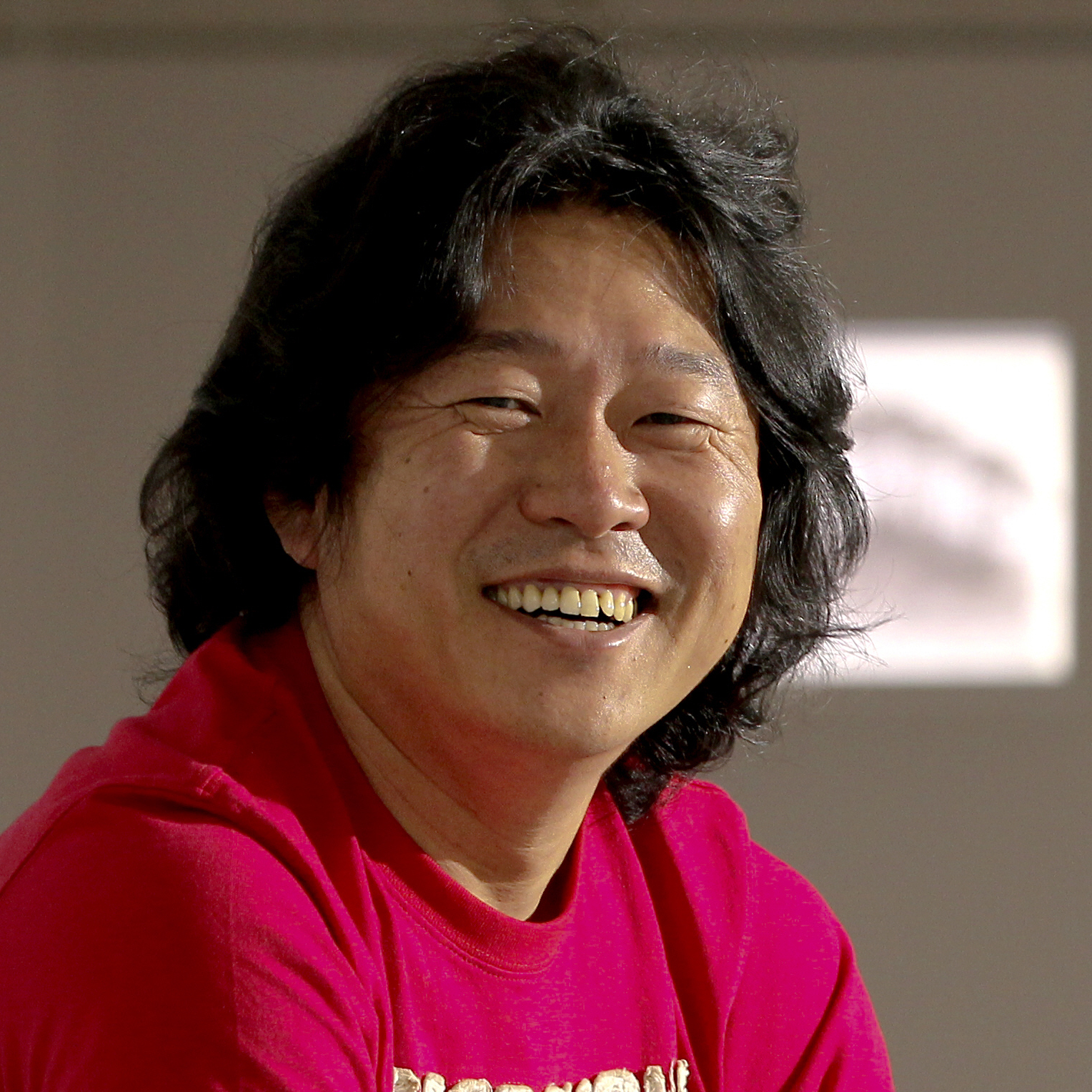
Bong-Chae Son
Birth
1967, Jeollanam-do Hwasun-gun
Genre
Painting , Installation


3-dimensional painting by Son Bong chae ― Paint 'the moment of splendor' at the boundary between tim
Lately, the name of ‘Son Bong-chae’ has frequently become an issue among the circles of art. As mentioned, his name goes with colorful and rhetorical words, such as 'bulletproof artist', 'cubist', 'LED-using painter', 'artist with his new technology cited in an art textbook', etc. However, Artist Son Bong-chae, now nearly in his mid 40's, is not such an artist abruptly emerging from anonymity out of the blue. He has been already a star artist coming into the limelight even about 10 years before.
It was at the 2nd Gwangju Biennale in 1997 when I, the writer saw Artist Son Bong-chae for the first time as reporter of a monthly magazine specialized in art. He was invited to the section of 'Authority' in the main exhibition, and as far as I remember the time, he attracted greater public attention so much to his work that he was accompanied with pieces of rhetoric, such as 'a promising artist produced from Gwangju Biennale' and 'the most noteworthy work'. It seemed even impossible for famous broadcasters and media to introduce Gwangju Biennale without mentioning his work. The most impressive work on exhibit that has been still at ongoing issue up to now was the piece of 207 bikes set out with their pedals turning in reverse. It was a piece of work with such bikes various in size and function hung all over from the ceiling inside the exhibition hall, whose characteristic machine roar overwhelmed the viewers. With the commentary that the roaring noise made by that bike installation work of art reminds viewers of such sound like ‘the moan of common people oppressed by authority', the work has become the symbol of the collective narrative of petit bourgeois, so to speak, the social weak'.
Besides, there are not a few noteworthy works of kinetic art (moving sculptures) to have been displayed by Artist Son Bong-chae in the 90's. For instance, the installation work of a machine saw with angel's wings criticizes the two-faced America and its allies posing a threat to the world peace through a modern version of the militarism. And with the installation sculpture of two boats continuously rowing as facing each other, the artist represents the reality of confrontation between the South and North Koreas. Every piece of his ardently created works delivers the strong message through its own theme of social issues contained in each work. As time goes on, however, the inclination of his work used to be like 'incisive slogans' has been changing into a mature form with 'metaphorical and gentle resonance' as gradually deepening its internal profundity. The expressive techniques have also greatly changed. At his atelier in Gwangju, I have met Artist Son Bong-chae in person who has his 12th private exhibition near at hand.
"It is not any similar landscape overlapped, but a scene or a landscape space-shared. In physical aspect, the work is divided into 5 faces, but in conceptual aspect, it is cut into pieces of time and space which could become a decade-fold or hundred-fold space, or a space transcending hundreds and thousands time. My work is intended for us not to view any simple landscapes or scenes in our sights, but meet them together with the time and history filtered into them behind through this. In the long run, what I also intend with this is not to face any phenomenon but its inside or essence."
Every word in his explanation already concisely mentions his work from start to end. In addition, it is fully exposed with which intention he has been engaged in his work and what is the point he wants to suggest. If I yet take the trouble to define the work by Son Bong-chae, it would be more likely to be a piece of ‘3D painting created in the space of illusion and fiction’. While each of the 5 different images is simply the 'physical efforts (environment)' in order to visually reproduce (embody) an object or a phenomenon, the empty space between such images is the 'conceptual setting' in order to realize the essence behind such phenomena. Therefore, we (viewers) are able to fully enjoy the essence of the 3D painting by Son Bong-chae only if simultaneously seeing through the 'painted landscape' outwardly appearing and the 'endlessly changing landscape' hidden in such space. Son Bong-chae's 3D landscape which looks like a featureless modern landscape at a glance, conveying the feelings to viewers as if they saw fantastic illusions in which past and present in chaos, and reminding viewers of a piece of Eastern painting in which the time seems to stop on the other hand. How are this artist's works created and what kinds of appealing features are hidden inside them?
In the works by Son Bong-chae, the outstanding feature is the fantastic space with the realms of reality and imagination mixed together. Various emotions are melted down in 'the 3rd landscape' expressed in the style of Son Bong-chae transcending the boundaries of time and space. The feelings of loneliness, nostalgia, remorse, joy, hope and despair reawaken the flame of soul asleep in abyss shaping like a chaotic mass in silence. For this reason, such a work created in the method of 3D painting by Son Bong-chae is an image of illusion and of existence at the same time.
The composition is set out in such ways making viewers feel as if they stood looking out over any objects from a distance for long. From here, with real images properly left out and reorganized, the scene looks simple as a whole. However, various elements coexist in such a work, such as whole and part, reality and illusion, past and present, change and standstill, etc., which adds visual impression in his works. They are almost like an image of living cells in the process of endless self-multiplication. What would be must-see features and appeal for viewers never to miss out in such works by Son Bong-chae?
'3D painting' created with new techniques.
The basic nature of a 2D painting depends on its background materials. The 5-fold bulletproof glass material of polycarbonate is used for Son Bong-chae's work. The artist creates the new concept of 3D painting beyond the limit of the general law of perspective as casting the LED light on a small panel from the back. This material was not used from the start. At the outset, photographic films, acrylic sheets or glass panels were used, but their demerits of discoloration, deterioration or fragility after a certain lapse of time have made him find new alternatives. The artist has been attracted to its merits of 300 times greater rigidity than acrylic sheet, lighter weight than glass and never deteriorating quality. In addition to this, he has improved the technical level of completion of his works by using LED with more than 50 years of the life span, a specially heat-treated patent product helping in the absorption of the heat from the lighting, etc. Accordingly, it costs him much as such materials become better. However, he does not care about it saying it is the artist's mission to offer 'the piece in best condition' to even a client.
Because the surface of the background image as thick as 0.2mm is made of glass material, it would be never easy for the artist to paint images with oil color. Besides, a paintbrush belonging under size No.1 (as fine as an eyeliner for girls' makeup) used here may help him bring delicacy to his work, which also takes him longer creation time of a piece. It takes him more than 2 weeks in full as investing average 10 hours a day for the completion of a work. A large scale of work requires a month or 2 to 3 months to be finished by him. In order to have an intended color line, the artist has to brush at least more than 3 to 4 times on a spot over and over again. For this reason, the artist confesses it is the most embarrassing moment when he paints on any wooden material.
The moment of time and space contained in his works
The whole thickness of a piece of work is basically about 10cm. It is because of this that each sheet of the background scene is spaced out 1.8cm apart. What is interesting is the way of composition of space set out with these five-fold panels. The paper named Jangji is used for the Korean traditional color painting. This is the paper made of the thin Korean paper of Hanji attached in multiple layers. This paper serves as background to resist when paint is repetitively colored. The background scene created by Son Bong-chae is exactly like the function of Jangji. For good color development in color painting, you may not have an original transparent vivid color until brushing the color thin and multiple times. In this way, Son Bong-chae also repetitively describes the same scene on each of the background face divided into several pieces to complete his work. This is the very reason why his works convey some misty feelings typical to Eastern (Korean) painting in spite of the quite Western materials used for his works. While the East has sought after the 'beauty of margin' from the 2 dimensional scene, Artist Son has expressed even such 'margin of speculation embracing time and space' which unites back and forth, right and left, inside and outside all the better. It is an 'original feature of 2D' holding the moment of time and space.
Son Bong-chae's 3D painting conveys different feelings dependent on perspective and viewpoint, amount and direction of light. This is like an aspect of light and shade expressed in an Indian ink painting or the aerial perspective that has evolved. At times, his work looks like a fantastic foggy scene, which brings unexpected inspiration to viewers as if they had been back from a time travel in a flash in the very next moment. The attraction instantly drawing viewers outside the scene of his work to the inside of it is because of the lyrical beauty unique to his work. His work feels as sweet as a warm sunlight shower and as mystic as images in a dream, making viewers fall into unnamed yearning following the loneliness struck by all of a sudden. What on earth is it in his painting that brings such an emotional shock wave to viewers this much in a flash.
The great epic bearing the spirit of the Korean people
On the face of it, Son Bong-chae's painting depicts idle scenery, but contains a theme never light behind the scenes. His work has joy, anger, sorrow, and pleasure of successive generations. As the artist makes it clear by saying, "I want to meet the time and history penetrated beyond simple scenery or images," viewers can also identify the authentic power borne in Son Bong-chae's works if they come to understand the behind-the-scene truth and essence in such superficial scenery in sight.
Each of his works has epic background concerning the place in each work. Mainly, each of them implies our sense of existence starting from the history in fetters we Korean have experienced to this day as having overcome such sorrows.
The most frequently selected subject matters are the national joys and sorrows as well as the grief in the Korean modern and contemporary history that the people have gone through, such as the Japanese colonial rule, the Korean War, the Gwangju Democratization Movement, etc. His work helps viewers look back at our identification through the consideration of 'the past' that have sunk into a sleep in the extremely painful history at the place of 'the present'. Though yesterday and today come in touch with each other as close as a piece of paper, his work makes viewers look at the fact in the face that the undeniable truth of history lies dormant in past and present, For example, the dreamlike landscape of bamboo woods in Damyang where seemingly even wizards could stroll about has a painful memory of the massacre happened to the residents slaughtered with bamboo spears during the Korean War in its background, and the geographical features of the Jiri mountain bragging 9f its mysterious and imposing appearance once served as base of the partisan. Also, I feel as if hearing the breathless sound of a citizen chased down along the unnamed lanes appearing ordinary on the day of the Gwangju Democratization Movement. In addition, the pine tree field looking immeasurably quiet has been the company soothing the souls of anonymous heroes died of a sudden in the ferocious Nakdong river battle. The artist's uncle died in the battle, too. He says even these days he makes sure to drop by the spot once a year. "It is not because he was just my family, but because I wanted to express my feelings about unnamed heroes who fleetingly perished through my works, instead," he says. Perhaps, his feelings like this may not be necessarily his own hope only. It is probably the destiny belonging to all of us.
Different from the first impression of Son Bong-chae's 3D painting that is magnificent and grand, the reason why his work brings easier and more friendly feelings free from overpowering or estranged sentiment is that his work contains the stories of our own. The earnest history has melted into our life in one to the bone. The reason for this is that his work does not feel heavy or sad at all even though such a work chooses sorrowful history like this as its theme is because the passionate energy like a flame burning from Son Bong-chae's work melts even our bitter sorrow in the past.
The guard connecting reality with illusion
The trees painted by Son Bong-chae bring unusual feelings to me. Pine trees usually representing the image of Korea and upright bamboos are painted in his work. Of course, where they stand are the dreary historical spots. It seems they sift out painful memories from the history at once. Like this, trees are not simply the part of the background. They are the other self of unnamed heroes silently defending the historical spots in place intact, and the eyewitness in the history. The alphabets occasionally written against the pine tree woods reflected on the surface of the river are the names of soldiers belonging to UN troops died in the Korean war. A number of heroes have fleetingly faded away into the backyard of history, but those trees silently standing in place through thick and thin are becoming the symbol of the Korean spirit. Also, they are like a buoy protecting us to be better off in this age.
Son Bong-chae say, "I'd rather hope to be an artist conveying thrillingly deeper and longer echoes of inspiration to viewers than such a person making his pace in a hurry just in pursuit of 'a jackpot' to hit." As looking at his 3D paintings, it seems to me that such a commitment of his is neither the pomposities on the spur of the moment, nor the excessive greed. He seems to become already aware of what to say and how to speak in order to exchange the bottom of his heart with others through his own work. The reason Son Bong-chae's work is expected is also because of his creation of 'his own style of a landscape' satisfying the outward beautiful aesthetic sense and the inward epic depth at the same time.
| Year | Education |
|---|---|
| 1995 | M.F.A Pratt Institute |
| 1991 | B.F.A Chosun University |
| Year | Exhibitions |
|---|---|
| 2011 | The Dream of Diaspora, Savina Museum of Contemporary Art, Seoul |
| 2010 |
The Sound of Water, Wind, Beacon Gallery, Seoul Korea Transparent, Opaque, Andy’s Gallery, Seoul Korea |
| 2009 | The Invitational Exhibition of a Young Artist of the year, Gwang-ju City Museum, Gwang-ju Korea |
| 2008 | Light+Building 2008, Messe Frankfurt, Germany |
| 2007 | Invited Exhibition in Commemoration of Opening Korean Cultural Center, Korean Cultural Center, Shanghai China |
| Year | Exhibitions |
|---|---|
| 2011 |
Bamboo Grove and Wind, Daedam Museum, Damyang Landscape of Illusion, Shinsegae Gallery Centum City, Busan |
| 2010 |
NEOSENSE-From Illusion to Three Dimension, SavinaMeseu, .Seoul Korea DIGI-FESTA, Biennale Exhibition Hall, Gwangju Korea Gwangju Biennale 10000 lives, Biennale Exhibition Hall, Gwangju Korea The1st Nanjing International Contemporary Art Biennale, Jiangsu Provincial Art Museum, Nanjing China Art Cologne' cologne. Germany |
| 2009 |
MindTopology_The Phases of 2009 Korea, National Taiwan Museum, Taijung Taiwan Project Part2, Gallery Strenger, Tokyo Japan |
| 2008 |
The 3rd Savilla Biennale, The Andalusian Centre of Contemporary Art / The Alhambra,
Savilla / Granada Spain
Sanglok Museum Opening Exhibition, Gwangju Museum of Art, Gwangju Korea Gwangju City Museum Opening Exhibition, Gallery Light, Seoul Korea |
| 2007 |
Arco Art Fair, Madrid Contemporary Art Museum, Spain Invited Exhibition by Korean Embassy, Smithsonian Museum, Washington United States Playing Arts, Hangaram Design Museum, Seoul Korea |
| Year | Awards |
|---|---|
| 1997 | Won the Grand Prix at the 1st Shinsegae Art Festival |


 l
l
 l
l
 l
l
 l
l